

What Are Ultrasound Probes?
Ultrasound probes are handheld devices that contain piezoelectric crystals which generate and receive high-frequency sound waves. When these crystals receive electrical current, they vibrate and produce sound waves that travel through the body. As these waves encounter different tissues, they bounce back as echoes, which the probe detects and sends to the ultrasound machine for processing into visual images.
The effectiveness of an ultrasound examination largely depends on selecting the appropriate probe for the specific examination type and patient characteristics. Different probes are designed with varying frequencies, shapes, and sizes to optimize imaging for different body parts and clinical applications.
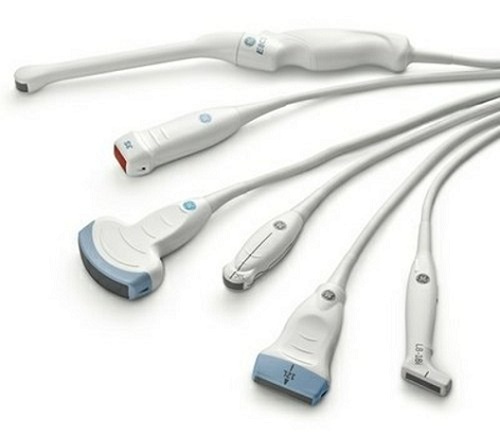
Probe types are most easily determined by looking at the shape of the probe. Each type of probe has a different specialty, but some can be used for a myriad of tests. Their shape and internal crystal makeup differentiate the way that they display images, and the frequencies that they operate on. We’ll explain some of the most popular ones below in detail.
Linear probes have a flat array and appearance. A linear probe’s piezoelectric crystals are arranged in a linear formation to create a straight sound wave. Linear probes can be applied to a wide variety of uses, such as vascular, breast, thyroid, tendon examinations and more. These probes typically have a rectangular beam with high near-field resolution and run at a high frequency to produce a better image resolution.
Convex probes (also called curved linear probes) have a curved array that allows for a wider field of view. The makeup of the piezoelectric crystals in the convex array probe are arranged in a curvilinear fashion. These types of ultrasound probes are complex and can have over 500 elements in their crystal makeup. Typically, these are great for more in-depth examinations. These transducers serve a variety of purposes and are great for vascular, abdominal, OB/GYN, nerve and musculoskeletal examinations. Because of its shape, convex probes are primarily used for abdominal scans due to their wider and deeper view.
Endocavitary probes have a much longer probe handle and a “U” shaped lens and array. These probes are used for scanning the inside of the body. Because of the shape, endocavitary probes do not have a great range of depth, but they allow for a wider field than even the convex probes.
Phased array or cardiac probes have a smaller handle with a square-shaped lens and array. Usually, they scan images of the heart. Phased array probes will have greater depth in order to reach the heart and produce an image. The phased array crystal arrangement is what gives this transducer its name. Phased Array transducers have fewer crystals in them, which means that the crystals fire in phases to create the image seen on the screen.
A 4D ultrasound probe, specifically designed for 4D (real-time 3D) ultrasound imaging, is used to capture live, dynamic images of internal structures, primarily in obstetrics and cardiology.
Choosing the appropriate ultrasound probe depends on several factors:
•Superficial structures (less than 5 cm): Linear probes with high frequencies
•Intermediate depth (5-15 cm): Convex or phased array probes with medium frequencies
•Deep structures (greater than 15 cm): Convex probes with low frequencies
•Pediatric patients: Higher frequency probes due to smaller body size
•Obese patients: Lower frequency probes for better penetration
•Elderly patients: Probe selection based on examination type and body habitus
•Vascular studies: Linear probes for superficial vessels, phased array for deeper vessels
•Abdominal examinations: Convex probes for standard exams, phased array for cardiac
•Small parts: Linear probes for high-resolution imaging
•Procedures: Linear probes for guidance, specialized probes for specific procedures
•Limited windows: Phased array probes for intercostal spaces
•Direct access: Linear or convex probes for direct contact
•Internal access: Endocavitary probes for internal examinations
Ultrasound probe technology continues to evolve rapidly, with several recent innovations improving diagnostic capabilities:
2D matrix arrays allow electronic beam steering in multiple dimensions, enabling true 3D imaging without mechanical movement. This technology provides faster volume acquisition and improved image quality.
New single crystal materials offer improved sensitivity and bandwidth compared to traditional piezoelectric materials, resulting in better image quality and deeper penetration.
Compact ultrasound systems with wireless probes have expanded point-of-care applications, allowing ultrasound use in remote locations, emergency settings, and field medicine.
Advanced probes now incorporate other imaging modalities like CT or MRI, allowing real-time ultrasound fusion with previously acquired images for improved diagnostic accuracy.
Modern ultrasound systems incorporate AI algorithms that help optimize image acquisition, suggest probe positions, and even assist with preliminary diagnosis.
Proper maintenance and handling of ultrasound probes are essential for ensuring image quality and patient safety:
•Follow manufacturer guidelines for cleaning procedures
•Use appropriate disinfectants for the probe type
•Pay special attention to endocavitary probes that require high-level disinfection
•Avoid dropping or impact to the probe
•Use appropriate cables and connectors
•Store probes in designated holders or protective cases
•Perform routine testing of probe functionality
•Check for damage to the probe surface or cable
•Document any performance issues
•Avoid extreme temperatures that could damage probe components
•Allow probes to acclimate to room temperature before use
•Follow manufacturer guidelines for storage temperature
Ultrasound probes are remarkable devices that have transformed medical diagnostics by enabling non-invasive visualization of internal structures. Understanding the different types of probes and their specific applications is essential for healthcare professionals to optimize image quality and diagnostic accuracy.
From linear probes for vascular imaging to endocavitary probes for internal examinations, each probe type serves specific clinical purposes based on its design, frequency, and capabilities. As technology continues to advance, ultrasound probes are becoming more sophisticated, portable, and specialized, expanding their applications in virtually every medical specialty.
For medical professionals, selecting the appropriate probe for each examination type is a fundamental skill that directly impacts diagnostic quality. For patients, understanding the different probes can help demystify the ultrasound examination process and alleviate anxiety about these valuable diagnostic tools.
As ultrasound technology continues to evolve, we can expect even more specialized probes with enhanced capabilities that will further improve patient care and diagnostic accuracy across the spectrum of medical applications.
Contact: Baron Zhang
Phone: +86 156 6575 0183
E-mail: info@hawmed.com
Whatsapp:00861566570183
Add: 2F, Building 6, Shuntai Plaza, 2000 Shunhua Road, Hightech Zone, Licheng District, Jinan, Shandong Province, China